
The organization of this project will be primarily online. The collection of blueprints will be grouped through the various stages of designing, construction, and historical to current day photography. By splitting up the collection by stage of development, the blueprints from each aspect of the Whitney House will get the recognition it deserves.
The design stage will showcase the collaboration between David Whitney Jr. and Gordon W. Lloyd for the Whitney House, as well as pay homage to the original home of David Whitney Jr., which was not deemed grand enough for the Whitney’s. Aspects of the design collection will also pertain to the David Whitney Building overlooking Grand Circus Park.
The construction phase will contain all information and blueprints pertaining to specialized aspects of the house, including the stone, woodwork, furnishings, windows, and landscaping. This will also include any specific information about the choice in location for the house. This phase will also look at the renovation of the David Whitney Building that was undertaken in 2011 to restore the building to its former glory.

The metadata language used for the description and organization of the David Whitney Jr. collection is the DublinCore Metadata Element Set (DC). The DC is the most simplistic metadata language and allows for ease of indexing and access to the collection (NISO, 2011). The Dublin Core Metadata Initiative (DCMI) lists the 15 standard metadata terms, which will be applied to this project:
Title, Subject, Description, Creator, Publisher, Contributor, Date, Type, Format, Identifier, Source, Language, Relation, Coverage, and Rights.
To ensure that the collection is searchable throughout a variety of databases and search engines, the subject headings used inside each DC term will adhere to the Library of Congress Subject Headings (LCHS). The collection will be using subject headings applied to historical architecture, historical Detroit, and information regarding David Whitney Jr. himself. These subject headings will be based on MARC entries for books regarding this information, as well as generally accepted subject headings in other databases. The subject headings within the DC will also follow the Library of Congress Name Authorities guidelines (LCNAF) to ensure that names included will be easy to search. For example:
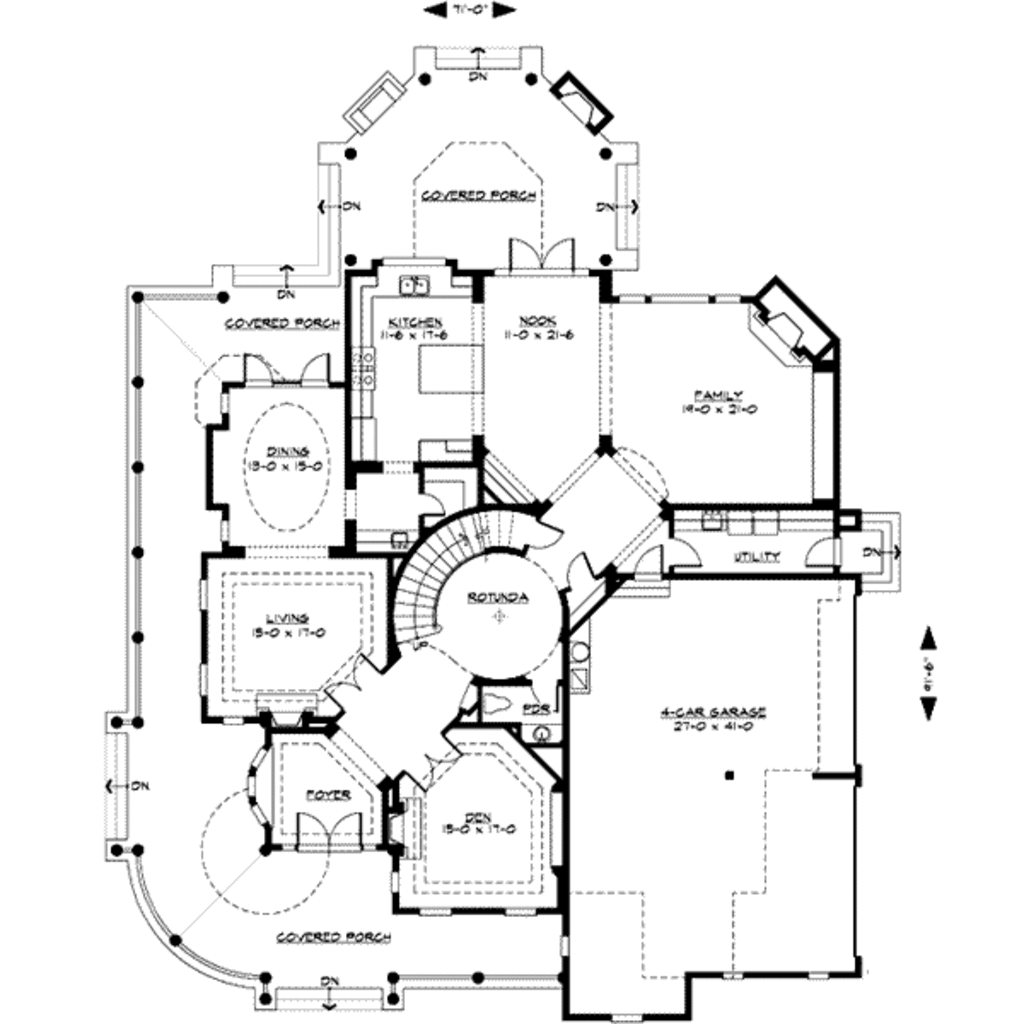
Title: The Whitney House Initial Blueprint
Subject: 19th Century Architecture, Historic Architecture, Detroit Architecture, Romanesque Revival, Gordon W. Lloyd Architecture
Description: Blueprint depicts the David Whitney Jr. House, built out of Pink Jasper from South Dakota featuring Tiffany stained glass windows. The house was built in the early 18th century by lumber baron David Whitney Jr. Built by Gordon W. Lloyd
Creator: Group #3 INF 6210
Publisher: Detroit Historical Architecture Association
Contributor: Wayne State University Library; Whitney House Collection
Date: 1800. 1894, 1986, 18th Century, 19th Century, 1800’s
Type: BLUEPRINT, SCAN
Format: JPEG, PNG, PDF
Identifier: Whitney House, David WhitneyJr. House, Gordon W. Lloyd, Design, Construction, Photography
Source: Whitney House Collection, David Whitney Jr. Collection; Wayne State University Library
Language: ENG
Relation: Detroit Historical Architecture Association
Coverage: Detroit, 42 19 00 N 083 02 00 W; 42.3167, -83.0333, 4421 Woodward Avenue
Rights: All information used in this presentation is protected under the Creative Copyright Law and intended for educational purposes only. The information here is not binding to any associations mentioned nor approved by them.
For more information about metadata, check out these resources:
Here is a short video explaining what metadata is.
Here is a website that further explains metadata.
Here is a webinar that also goes further in-depth about what metadata is and how to compose it.
Sources:
Dublin Core Metadata Initiative. (2018). DCMI specifications. Retrieved November 18, 2018 from: http://dublincore.org/specifications/
Getty Research Institute. (2017). Getty thesaurus of geographic names online. Retrieved November 25, 2018 from http://www.getty.edu/research/tools/vocabularies/tgn/index.html
Library of Congress. (2018). Library of congress authorities. Retrieved November 26, 2018 from https://authorities.loc.gov/
Library of Congress. (2018). Marc standards: library of congress network development and marc standards office. Retrieved October 30, 2018 from https://www.loc.gov/marc/
Riley, J. (2011). Understanding metadata: what is metadata and what is it for? National Information Standards Organization.
University of California: Santa Cruz. (2018). University library: metadata creation. Retrieved November 24, 2018 from https://guides.library.ucsc.edu/c.php?g=618773&p=4306386
 expand his lumber business into Ohio, Indiana, Michigan’s Upper Peninsula and Pennsylvania. His wealth afforded him many luxuries. With his interest in real estate, he started to buy up properties. One of which was the Grand Circus Park Building (1890). He redesigned the building and started construction on a five-story building, which was known as the David Whitney Building. The David Whitney Building ended up being 21,000 square feet. The building project started in 1890 and finished in 1894 costing about $4000,000. He used Tiffany glass windows and South Dakota Jasper stone. It also had a functional elevator. David Whitney Jr. passed away in 1900 and his family remained there until 1920. After the family moved out it became the headquarters of the Wayne County Medical Society. In 1972, the house was registered on the National Register of Historic places. In 1986, it became a restaurant and is that to this day.
 David Whitney Jr. Collection